Size Matters
Scalable digital works require us to make decisions about size constantly, in real time.

related articles
A Question of Artistic Labour
Or why art has long been about ideas, not just physical labour.
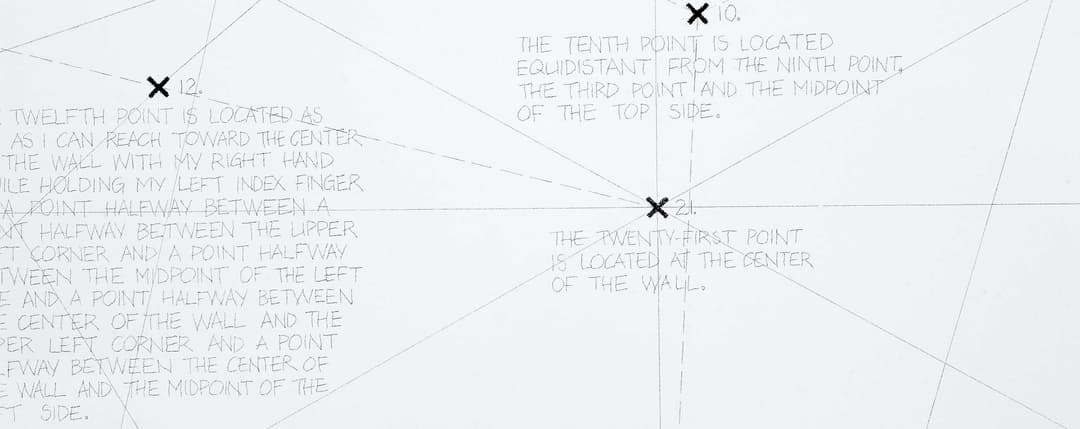
<h3 dir="ltr">I often hear people dismiss AI-generated art due to the misperception that "prompting" lacks artistic labour. After all, if you just type out what you want to see and the machine churns an image out based on your words, <em>did you really make art</em>? The mental image of the toiling, struggling artist is so pervasive, that people almost resent the absence of physical labour in contemporary artistic practices. It may surprise most to discover that prompt-based art has actually been around for nearly a century.</h3> <p dir="ltr">One of my personal favourites is:</p> <blockquote> <p dir="ltr">A 6” (15 cm) grid covering the walls. Lines from corners, sides, and center of the walls to random points on the grid.</p> <p dir="ltr">1st wall: Red lines from the midpoints of four sides;</p> <p dir="ltr">2nd wall: Blue lines from the four corners;</p> <p dir="ltr">3rd wall: Yellow lines from the center;</p> <p dir="ltr">4th wall: Red lines from the midpoints of four sides, blue lines from four corners;</p> <p dir="ltr">5th wall: Red lines from the midpoints of four sides, yellow lines from the center;</p> <p dir="ltr">6th wall: Blue lines from four corners, yellow lines from the center;</p> <p dir="ltr">7th wall: Red lines from the midpoints of four sides, blue lines from four corners, yellow lines from the center.</p> <p dir="ltr">Each wall has an equal number of lines. (The number of lines and their length are determined by the draftsman.)</p> </blockquote> <p dir="ltr"><br>These are instructions written by Sol Lewitt in 1975, for <em>Wall Drawing 273</em>, an artwork intended to be realised by “a draftsman,” per Lewitt’s own instructions, who is likely a museum worker, or even an intern.</p> <p dir="ltr"><strong><img src="https://cdn72109500.ahacdn.me/news/upload-1586705043.jpg" alt="Sol Lewitt, Wall Drawing 273, 1975, Image: San Francisco Museum of Modern Art" width="1324" height="1146"><br></strong><span class="custom-span">Sol Lewitt, <em>Wall Drawing 273</em>, 1975, Image: San Francisco Museum of Modern Art</span></p> <p dir="ltr">As the artist of the artwork, Lewitt’s most direct input is that of creating the instructions. In today’s digital art lexicon, we would refer to said set of instructions as a prompt. In each realisation of the work, the now 49-year-old prompt should result in a geometric, large-scale work of art, likely iterated over time with different results, drawn by different people, with different materials to make the lines, as the work is revisited, or sold to another institution or collection.</p> <p dir="ltr">Lewitt and plenty of other artists have historically delegated their labour, and there was a time when the contemporary art world lauded them for it. One could even argue that Duchamp’s found sculpture, <em>The Fountain</em> (1917), was a result of delegated labour, and an unintentional one at that, since it was utilitarian, rather than artistic.</p> <p dir="ltr">So how is writing a prompt for Midjourney or DALL-E to dream something up all that different than what Lewitt did 50 years ago? Or, if it isn’t, why are we hellbent on questioning the artistry of the prompter and the artistic legitimacy of the outcome?</p> <p dir="ltr">Instructions were a critical part of many artistic experiments in the 20th century, most notably during the Fluxus movement, which emphasised process over end result. There was a performative focus that insisted on framing the transient act of making art as art itself. Although not a Fluxus artist himself, Lewitt is irrefutably part of the Western art canon.</p> <p dir="ltr"><img src="https://cdn72109500.ahacdn.me/news/upload-1145181531.jpg" alt="Robert Rauschenberg, White Painting [three panel], 1951, Image: San Francisco Museum of Modern Art" width="1661" height="1124"><br><span class="custom-span">Robert Rauschenberg, <em>White Painting [three panel]</em>, 1950, Image: San Francisco Museum of Modern Art</span></p> <p><strong> </strong>Pre-dating Lewitt by two decades, Robert Rauschenberg has white paintings produced in the 1950s that he had in fact delegated to be produced by others per his instructions, with both the act of delegating and his absence being part of the artistic process. Famous Fluxus artist John Cage’s <em>0’00” </em>(1962) has no musical notes and is instead comprised of a single phrase of instruction: </p> <blockquote> <p dir="ltr">In a situation provided with maximum amplification, perform a disciplined action.</p> </blockquote> <p><strong> </strong>There are extraordinary examples of how different artists, musicians, and orchestras interpret this prompt. Not only is each interpretation valid, but more importantly, the more people attempt to realise this simple phrase, the bigger and more interesting the artwork becomes. If anything, it is kept alive because of how intriguing and exciting it can be to reinterpret the instruction.<strong> </strong></p> <p dir="ltr">None of these examples are intended to frame AI-generated artworks as requiring precedent to be artistic. They can be artistic regardless. But hot on the heels of a <a href="https://www.artnews.com/art-news/market/christies-ai-art-sale-augmented-intelligence-controversy-surpasses-expectations-1234734870/">somewhat controversial auction of AI-generated works at Christie’s</a>, context seems necessary. The current Luddite position against prompt-based artworks undermines not only today’s digital creations but the better half of the last century of art. </p> <div class="interactive-block">691</div> <p>The misconception that AI-generated imagery is lacking in artistic labour due to its instruction-based process, could perhaps be attributed to a general lack of Art History education. Delegating labour may create the impression that there is no real artwork being made, a scepticism that is in part fueled by the bitter aftertaste of the NFT bubble, where overnight, everyone was a digital artist peddling iterations of pixel-art sketches of bulldogs and the like. The damage the hyper-commodification of digital visuals has done to digital art will take some time to fix in the public psyche. In the meantime, however, it is worth recognising that intellectual labour, though harder to measure, can and does exist in prompt-based AI works of art. The more difficult notion we are wrestling with today, is the painfully ableist question of whether physical mastery of manual tools and/or our bodies is a prerequisite for art to be considered valid.</p> <h3 dir="ltr">In other words, does the ability to eloquently and strategically verbalise one’s imagination make one an artist?</h3> <p dir="ltr">There are countless ways to generate visuals based on prompts in DALL-E and Midjourney, two of the most popular visual AI engines that are publicly accessible today. Learning them takes time, as does honing the image and communicating with an intelligence that does not quite yet understand reality. Sometimes, the artistry lies in knowing which of the generated images to select, the way a film director might choose a take of a scene, or a photographer might choose a frame out of 50 shots of the same subject.</p> <p dir="ltr">Sure, these algorithms mine the Internet for visual references, which include imagery not necessarily done by the artist writing the prompt, but unless we banned collage-making while no one was looking, AI is not doing something that every teenager with access to print issues of Vogue and Time and Blue Jean hasn’t done in the 80s or 90s (sorry Gen-Z, your subscriptions are digital).</p> <p dir="ltr">Language, more than anything else, holds the key to understanding the artistry and labour that goes into AI-generated artworks. When generating an image of the sky, typing in “blue” is not the same as “cerulean,” and understanding the difference goes a long way. But the more exciting part of it all is that even if you type in “cerulean,” no two images can be the same.</p> <p dir="ltr">Cage and Lewitt would have had a field day.</p> <p> </p>
Are NFTs making a comeback?
Marina Abramovic has ventured into NFTs once again. Three years after the initial bubble burst, the contentious digital revolution may be receiving some much needed CPR, administered by the queen of performance art herself.
<p dir="ltr">2021 was an odd year for contemporary art, and I often think about it in terms of whiplash. After all, it was the year we had the most expensive jpeg sale of all time, BEEPLE’s <em>Everydays</em>, sold at Christie’s for nearly $70,000,000. </p> <p>Shortly after, what could have been a revolutionary mechanism for the distribution of digital art became mired in speculative investments and cash-grabs, creating a general culture of toxicity. Perhaps it was the arrogance with which the underlying technology was dubbed Web 3.0, insisting that this was the canonical path forward for the internet. Perhaps it was the adoption of commercialised street culture terminology, with artists promoted via "limited edition drops" rather than exhibitions, blurring the line between the commercial and the artistic. Whatever the cause might have been, the enthusiasm surrounding NFTs soured quite quickly.</p> <p>Plenty of people during Art Basel Miami in those years would parrot the myth about how unsafe digital artworks were on USBs and hard drives, before the blockchain; how this was the safest and best way to preserve digital art and a perfect application of blockchain technology. They were all surprised when I told them there was not, nor had there ever been, an epidemic of digital art theft. If anything, insisting on digital wallets to store expensive works of art made them more vulnerable, since<a href="https://nftnow.com/features/some-of-the-costliest-nft-thefts-of-all-time/"> hacking someone’s account or finding their passwords remotely is fundamentally easier than breaking into someone’s house or art storage</a>. Ironically, many people have since begun storing their digital assets on "cold wallets" which are, you guessed it, USBs and hard drives. This is certainly not a problem, merely proof that the nascent culture surrounding NFTs needed some time to figure itself out.</p> <p>When people referred to BEEPLE as the first major digital artist in those years, I would exasperatedly point them in the direction of Harold Cohen, Vera Molnár, and Charles Csuri, whose practices predated BEEPLE’s by more than half a century. </p> <p dir="ltr">Were they available on the blockchain at that time? No.<strong> </strong></p> <p><strong><img src="https://storage.googleapis.com/taex-storage-prod/news/upload-1121124761.jpg" alt="Harol Cohen, AARON" width="1281" height="1242"><br></strong><span class="custom-span">Harold Cohen, <em>AARON KCAT</em>, 2001, Image: whitney.org</span></p> <p dir="ltr">The inherent problem with marrying an investment mechanism with the mode of transport and display for art, is that said art became strictly evaluated by its market viability. Are prices inflated in the analogue art market? Sure, but no one has a fire sale on their Rothkos if the DOW has a bad day. </p> <p>An online culture that decides digital images of cartoon apes are worthy of investment, on its own, can be perfectly valid. The conversation gets murky when the PR machines at work behind the scenes then <a href="https://news.artnet.com/multimedia/the-art-angle-podcast-bored-ape-yacht-club-2094073">insist that said cartoon apes have the same cultural and commercial value as a Rothko or a Warhol</a>. This insistence on equivalence may have convinced some of the 20 to 45 age demographic that prioritized investment possibilities and social clout; but for the most part they could not, and did not, convince the art world.</p> <p>When the bubble burst, being associated with cryptocurrencies made most NFT artists, and their (largely online, and somewhat chaotic) fanbase, undesirable. A volatile market that values you based on your tradeability is not a market that will protect you. Hyper-commodification of digital artworks inevitably means they exist as assets first, artworks second.</p> <p>But in 2025, the blockchain, crypto-currencies, and yes, NFTs, continue to exist. So now that the dust has hopefully settled, the questions we have to grapple with are:</p> <p>-Which, if any of these artists, actually have cultural value?</p> <p dir="ltr">-Can we protect said cultural value from market volatility?</p> <p dir="ltr">-What do we do with this billion dollar digital infrastructure?</p> <p dir="ltr">In 2022 I conducted an interview with Dimitri Ozerkov, former Head of Contemporary Art at the State Hermitage Museum in St. Petersburg, who curated the very first institutional NFT exhibition in 2021. He had an inventive approach: </p> <p>"I was curious whether we could create the conditions in which we could answer the question, what is art in [NFTs]… what is artistic in there? In order to create these conditions, it was clear that we had to somehow remove these NFTs from the market, or block them."</p> <p>This was a potential issue that had not yet arisen in 2021: Namely, the possibility of a work on-chain being transacted during an institutional exhibition, perhaps because of the institutional exhibition. Also worth noting was the possibility of sabotaging a work on view. After all, if an image or video file is hosted remotely, whoever owns the NFT controls it, even if it's being displayed in a museum.</p> <p>Commodification, rather than destruction, was likely Ozerkov’s primary concern. The urgency with which NFTs can be traded can sometimes come at the cost of cultural capital. Institutional presentations will often raise an artist’s profile and their prices. But while a museum presents a unique work of art, the work does not change ownership multiple times in the span of a day, let alone a month, or the duration of the exhibition. A collector could see a piece in a museum and decide to acquire it, or pursue it at the very least, but our experience of that artwork is kept separate from said pursuits.</p> <p>Perhaps this is the crux of the problem, and one that is gradually being addressed. Not that everything might be for sale, but that the feeling of constantly witnessing something being bought and sold erodes the possibility of artistic enjoyment and wonder.</p> <p>Since the initial NFT frenzy, blockchain enthusiasts have begun to embrace its potential for poetics a little more, with the introduction of performative works of art, such as Operator’s choreographies, collectible as digital files, and London-based digital art gallery TAEX’s recently launched <a title="MAE " href="https://mae.taex.com/" target="_blank" rel="noopener">MAE project</a> with Marina Abramovic. That Operator rode the initial NFT boom with such grace and continues to soar nearly five years in, is proof that there is something worth exploring in the intersection of blockchain technology and performance art. </p> <p dir="ltr"><img src="https://storage.googleapis.com/taex-storage-prod/news/upload-29495414.jpg" alt="Operator, Human Unreadable" width="1174" height="808"><br><span class="custom-span">Operator, Human Unreadable, 2013, Image: operator.la</span></p> <p>Conversely, the launch of <a title="MAE" href="https://mae.taex.com/" target="_blank" rel="noopener">the MAE project</a> was almost exactly the same as old NFT launches, so much so that it surprised many in the digital art industry who had moved away from complicated pre-sale mechanics, bonuses, and various artificial bottlenecks designed to drive up demand. Three separately timed drops, all indicating different stages of Abramovic’s life and practice, lead to a final "minting" or activation of NFTs on-chain, which would elevate the NFTs further. From a performance standpoint, segmenting and incorporating the transaction element into the artistic process is a worthy metacommentary. And it is a commentary that clearly resonates, as at the time of this article’s publication, half of the several thousand NFTs in the collection had already pre-sold.</p> <p dir="ltr"><img src="https://storage.googleapis.com/taex-storage-prod/news/upload-436554840.jpg" alt="Marina Abramović Element" width="1080" height="1920"><br><span class="custom-span">Marina Abramović Element, Image: TAEX</span></p> <p>This Profile Picture (PFP) style of collecting, wherein owners of NFTs immediately make the artwork their profile image thumbnail as a form of social clout, has always reminded me of trading cards. There is a public dimension of ownership that centers around the collector, rather than the artwork, but if these are the digital streets where a new kind of collector roams, it is understandable that they want to flex, culturally. But much like the hyper-commodification I mention, perhaps there is a way to balance this enthusiasm with stewardship and reverence for the work; which in turn would allow for NFTs to have a longer shelf life, and cultural value, than a profile picture thumbnail.</p> <p>The fact that it is a project that will last over a year also subverts most traditional NFT launches that focus on hype-driven urgency and scarcity. The one crucial difference over the majority of the NFT projects of yore, is that we are dealing with an artist who already has cultural capital.</p> <p>Marina Abramovic is certainly a worthy choice for mainstream blockchain resuscitation, and as good a litmus test as can be. Whether the (art) world is ready for NFTs to make a comeback, time will tell.</p> <p> </p>
Stay Tuned
Be the first to learn about new collections, events, and more.